
Samsung’s first major Galaxy Unpacked event of 2026 kicks off tomorrow, February 25. If you watch the official livestreams or read the corporate press releases, Samsung is going to spend two hours bombarding you with buzzwords about the new Snapdragon 8 Elite Gen 5 processor, “Perplexity AI” integration, and refined 200MP camera arrays.
But if you are paying attention to the supply chain leaks, the biggest upgrade coming to the Galaxy S26 Ultra has absolutely nothing to do with AI or photography. It is all about stopping the person sitting next to you on the metro from reading your WhatsApp messages.
Thanks to a massive breach in retail protocol—where early African and UAE retail units were sold to YouTubers days ahead of the launch—we finally have a real-world look at Samsung’s highly anticipated “Zero-Peeking Privacy” display.
Here is a deep dive into how Samsung’s new “Flex Magic Pixel” technology works, why it could kill the market for third-party screen protectors, and the one massive flaw that Samsung is praying you won’t notice until after you pre-order.
What is “Zero-Peeking Privacy”?
If you have ever used your phone on a crowded bus, in an elevator, or at an airport terminal, you are familiar with the anxiety of “shoulder surfing.” You lower your screen brightness, cup your hand over the display, or tilt the phone awkwardly just to enter a banking password or read a sensitive work email.
For years, the only solution has been to buy a cheap, $10 privacy screen protector from Amazon. They work, but they also permanently ruin your phone’s display quality, making your $1,300 flagship screen look dim, grainy, and cheap.
The Galaxy S26 Ultra is completely eliminating the need for those accessories.
According to the leaked retail units and One UI 8.5 firmware teardowns, Samsung has built the privacy filter directly into the OLED panel itself. When you toggle the feature on from the Quick Panel, the phone dynamically alters how light is emitted from the screen.
Say goodbye to cheap screen protectors. The S26 Ultra limits viewing angles at the hardware level.
The Hardware: Flex Magic Pixel Technology
This isn’t just a software trick that turns down the brightness. This is a fundamental shift in display engineering.
Industry insiders confirm that Samsung Display is utilizing a new technology called Flex Magic Pixel. By controlling the specific direction of the light emitted by individual pixels, the display can artificially narrow the viewing angle on command.
When you look at the S26 Ultra straight on, the screen remains vibrant, sharp, and perfectly readable. But if someone looks at your phone from an angle of 30 degrees or more, the screen instantly appears pitch black or severely obscured.
The leaked One UI 8.5 software shows exactly how customizable this is:
- The Quick Toggle: You can turn it on and off instantly from your notification shade.
- Maximum Privacy Protection: A secondary mode that aggressively darkens the side-angle view for highly sensitive environments.
- App-Specific Automation: You can set the privacy display to turn on automatically the second you open specific apps—like your crypto wallet, banking app, or work email.
The “Senior Analyst” Reality Check: The Hidden Trade-Off
On paper, this sounds like the greatest display innovation since the jump to 120Hz refresh rates. But as a tech analyst, my job is to look past the marketing gloss.
When you bake a privacy layer directly into a screen, there is almost always a severe hardware trade-off.
If we look at the laptop industry, HP has been offering a similar feature called “SureView” for years. And it is notoriously terrible. Even when the HP SureView feature is turned off, the physical filtering layer ruins the display’s natural viewing angles, making the screen look washed out unless your head is perfectly centered.
Samsung is using OLED, not LCD, which gives them a massive advantage. But the laws of physics still apply. The biggest questions Samsung needs to answer at Unpacked tomorrow are:
- Does the Flex Magic Pixel layer reduce the maximum peak brightness when turned off? (The S25 Ultra hit 2,600 nits. Can the S26 Ultra match it without looking muddy?)
- What is the battery drain? Forcing the pixels to dynamically shape light direction requires immense processing power. Will turning on “Maximum Privacy Protection” drain your 5,000mAh battery twice as fast?
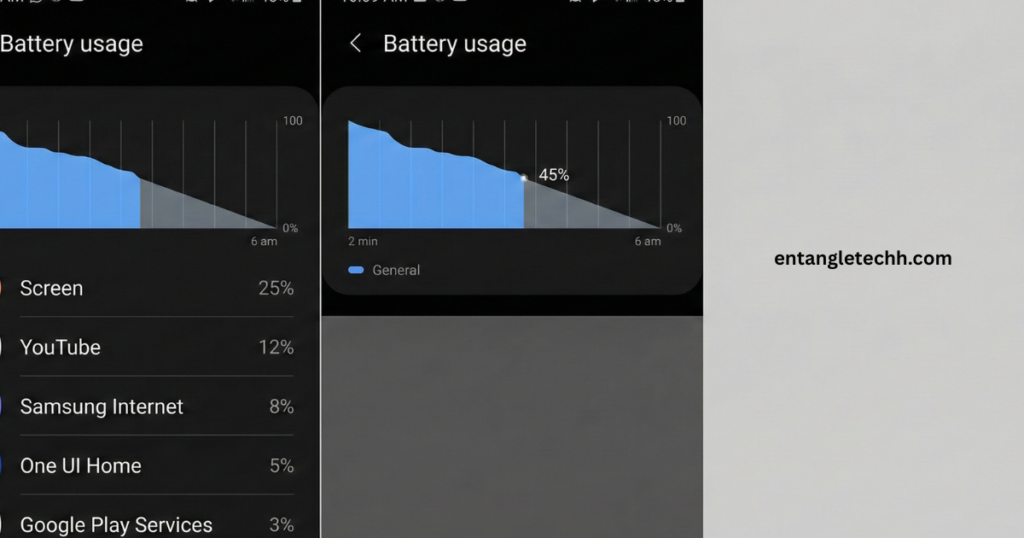
The S26 Ultra features the same 5,000mAh battery as its predecessor. Powering a dynamic privacy display might result in a noticeable hit to screen-on time.
The Verdict: Should You Pre-Order Tomorrow?
Tomorrow, Samsung is going to open the floodgates for pre-orders, likely dangling free storage upgrades and trade-in bonuses to get your money before the reviews drop.
My advice? Hold your fire.
The Galaxy S26 Ultra is undeniably a powerhouse. But early unboxing leaks also confirmed that Samsung is repeating last year’s mistakes—the S-Pen still lacks Bluetooth, and the core battery hardware remains unchanged.
The “Zero-Peeking” display is a brilliant concept that solves a real-world problem. But until we can test exactly how much it impacts the battery life and the base display quality, spending upwards of $1,300 on a pre-order is a massive gamble.
Let me know in the comments: Would you sacrifice a little bit of battery life to guarantee nobody can ever read your screen in public again?
Also read:
GTA VI Reportedly Delayed to 2027? Why the “Official Denial” Should Worry PC Gamers.
Firefox Just Added an “AI Kill Switch”: Why I’m Switching Browsers Today